
Key takeaways
- Xona Space Systems launches six satellites this month to begin commercial operations of Pulsar, a precision navigation constellation offering centimeter-level accuracy compared to GPS's meter-level precision.
- The company solved key engineering challenges including satellites that maintain time through ground-based references rather than expensive atomic clocks, and compatibility with existing GPS receivers via software updates.
- Xona has raised over $300 million including $20 million from the U.S. Space Force, with full coverage planned for the U.S., Europe, Japan, and South Korea by 2028.
Xona Space Systems is preparing to demonstrate a privately built alternative to GPS, with six satellites scheduled to launch into orbit this month. The startup’s approach targets a fundamental gap that government-operated navigation systems have left unfilled: signals precise enough for centimeter-level positioning, strong enough to penetrate buildings and urban environments, and difficult to jam or spoof.
GPS and the competing satellite networks built by Europe, China, and Russia deliver tremendous value. But their limitations have become constraints for advancing industries. Meter-level precision works for maps and basic location services, but fails to meet the demands of precision agriculture, autonomous vehicles, or infrastructure requiring coordinated timing across global systems. These networks are also vulnerable to jamming and spoofing, a vulnerability that has become increasingly apparent in military conflicts.
The Stanford Origins
Xona was founded in 2019 by five engineers who met while pursuing graduate degrees in aerospace at Stanford University. The founding group, including Tyler Reid, emerged from conversations exploring whether the performance gaps in satellite navigation represented a genuine business opportunity. Reid had written his doctoral thesis on low-earth orbit satellites and navigation capabilities, providing the technical foundation for the company’s core concept.
The co-founders faced skepticism about the market itself. Competing against GPS seemed unreasonable—the service is free, widely deployed, and deeply embedded in global infrastructure. But Brian Manning, the company’s CEO, shifted his perspective after analyzing the actual market structure. Speaking with TechCrunch, Manning explained that the real market isn’t the navigation service but the hardware ecosystem. Billions of devices requiring positioning and timing are manufactured annually, and manufacturers are actively seeking performance improvements that GPS cannot deliver.

Engineering a New Approach
Timekeeping Without Atomic Clocks
Satellite navigation systems typically carry expensive atomic clocks onboard to maintain the precise timing required for positioning calculations. Xona engineered around this requirement by designing satellites that maintain timing accuracy through constant communication with ground-based reference sources, exploiting the short distances available in low-earth orbit. This architectural choice dramatically reduces the per-satellite cost compared to traditional approaches.
Compatibility with Existing Hardware
Rather than requiring customers to deploy entirely new receiving hardware, Xona designed its signals so that existing GPS receivers can process them with only minor software modifications. This compatibility approach accelerates market adoption while streamlining regulatory approval for operating the navigation network. Users can integrate Xona’s service without overcoming the friction of equipment replacement.
Precision and Resilience
Xona’s Pulsar constellation will transmit signals strong enough to be received indoors and in densely built urban areas where traditional GPS struggles. That signal strength provides natural resistance to jamming and spoofing attempts. The precision leap is substantial: centimeter-level accuracy compared to the meter-level precision that GPS provides, representing roughly 100 times better positional accuracy.
The Launch and Constellation
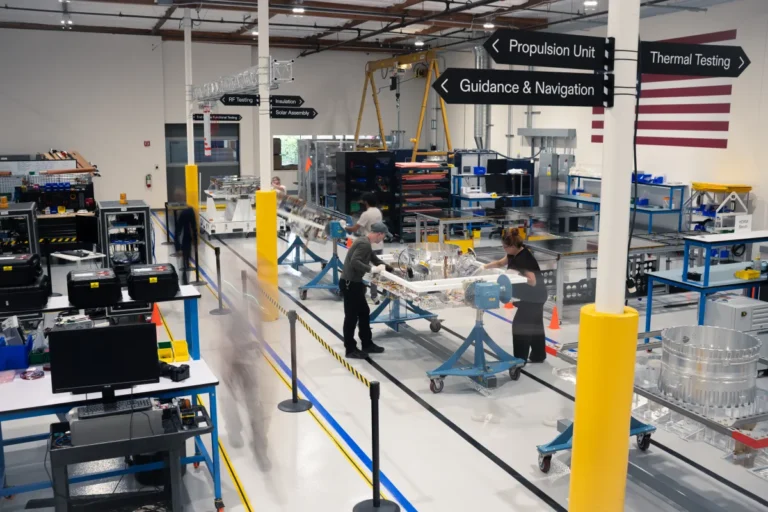
This month’s launch will carry six satellites aboard a SpaceX rocket. Four of the satellites follow the design of a prototype that Xona successfully tested in orbit last year, built using a satellite platform from Aerospace Labs. The remaining two satellites represent a transition point: they were constructed entirely by Xona at its Burlingame, California headquarters and will serve as the design foundation for the full Pulsar constellation.
The operational constellation, Pulsar, will eventually comprise 258 satellites. Once in orbit, the initial six satellites will pass over the mid-latitudes approximately eight times each day. This coverage pattern enables Xona to begin beta testing with commercial customers. The company has targeted 2028 for complete operational coverage across the United States, Europe, Japan, and South Korea.
Market Demand and Early Adopters
Ian Gough, CEO of TimeBeat, a company providing precision electronic timing services, has committed to participating in Xona’s beta testing phase. TimeBeat will use the program to validate and refine the timing services it delivers to customers globally, signaling that demand exists among infrastructure operators for a better precision timing alternative.
The broader market extends across multiple industries. Precision agriculture relies on accurate positioning for autonomous equipment. Construction and surveying operate under GPS limitations that restrict efficiency. Autonomous vehicles cannot operate safely at scale with GPS as the sole positioning source. Energy and telecommunications infrastructure requires globally coordinated timing that GPS cannot reliably deliver. These applications represent a market measured in billions of devices, creating substantial economic opportunity for a system offering better performance.
The U.S. Government’s Strategic Investment
Xona has raised more than $300 million from venture investors since its founding in 2019, including a $20 million investment from the U.S. Space Force. While Xona operates as a commercial enterprise, the Space Force’s involvement reflects genuine strategic concerns. GPS jamming and spoofing have become routine tactics in recent conflicts, revealing the vulnerability of systems that depend entirely on a single navigation source. A technically resilient alternative developed with U.S. technology provides a counterweight to these vulnerabilities.
The government’s interest underscores why Xona’s approach differs fundamentally from attempting to compete directly on price or convenience with free government services. The government itself recognized that the performance and resilience limitations of existing systems represent a national strategic concern worth funding.
Building Autonomous Systems
Tyler Reid’s background illuminates the connection between Xona’s technology and future mobility. Before joining the startup, Reid worked on autonomous vehicle development at Ford. In that role, he encountered the precision and reliability constraints that GPS imposes on self-driving systems. Autonomous vehicles navigating urban environments require positioning accuracy far exceeding what GPS reliably delivers, especially when facing spoofing attempts.
Reid now serves as Xona’s CTO, positioning the company at the intersection of its current commercial opportunity and the autonomous future. Brian Manning articulated the long-term vision by comparing autonomous vehicles to civil aviation. Aviation maintains the highest safety standards across all mass transportation. Xona’s goal is enabling autonomous ground vehicles to achieve equivalent safety assurance through precision navigation and signal resilience that drivers can rely on as thoroughly as airplane passengers trust aviation systems.
Source: TechCrunch
Frequently Asked Questions
How is Xona's system different from GPS?
Xona's signals penetrate buildings and dense urban areas where GPS fails. They also resist jamming and spoofing attacks, vulnerabilities that have become apparent in recent military conflicts.
When will Xona's service be available?
Six satellites launch this month, enabling beta testing with customers. Full operational coverage across the U.S., Europe, Japan, and South Korea is targeted for 2028.
Why would anyone pay for navigation when GPS is free?
According to CEO Brian Manning, the market isn't the navigation service itself but the billions of navigation-capable devices manufactured annually. Manufacturers seek higher precision and reliability than GPS provides for applications like autonomous vehicles and precision agriculture.
